
Imagine waking up one morning and hearing your dog barking near the front door. You have always wondered what your dog is trying to tell you. Is it hungry? Does it want to go outside? Is it feeling anxious, or has it noticed something unusual?
Now imagine having a small AI-powered device that analyzes the barking, examines your dog’s body language, and tells you that your pet may want to go outside.
Sounds fascinating, doesn’t it?
What if the same technology could help scientists understand the calls of birds, the sounds of whales deep in the ocean, the communication patterns of elephants, and even the sounds made by insects?
For centuries, humans have observed animals and tried to understand their behavior. We know that animals communicate with one another, but we still have much to learn about the information hidden in their sounds, movements, and other signals.
Today, artificial intelligence is opening new possibilities in this field. Researchers are using AI to analyze enormous collections of animal recordings, identify recurring sound patterns, and investigate how those sounds relate to animal behavior.
This has led to an exciting question: Could technology eventually help humans understand animals in a way that resembles translating one human language into another?
You may have heard the term Quantum AI in connection with this idea. But what does it actually mean? Does understanding animal communication require a quantum computer? And can modern AI really translate a dog’s bark or a whale’s call into English?
Let’s explore the science, technology, current research, practical applications, and limitations behind this fascinating field.
What Is Quantum AI? How Artificial Intelligence Is Helping Us Understand Animal Sounds and Communication:-
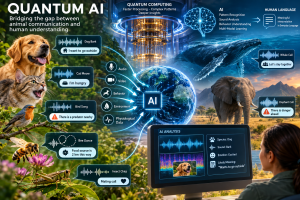
1. What Is Quantum AI?
Quantum AI is a term associated with the combination of quantum computing and artificial intelligence.
Although these two technologies can potentially work together, they serve different purposes.
What Is Quantum Computing?
Traditional computers process information using bits, which represent either 0 or 1.
Quantum computers use quantum bits, commonly called qubits. Under the principles of quantum physics, qubits can exhibit properties such as superposition and entanglement.
These properties may allow quantum computers to solve certain specialized problems in ways that differ from conventional computers.
However, quantum computers are not automatically faster or better at every task. Their advantages depend on the problem being solved, the algorithm being used, and the capabilities of the hardware.
What Is Artificial Intelligence?
Artificial intelligence refers to computer systems that can perform tasks such as recognizing patterns, analyzing information, generating language, and making predictions based on data.
For example, an AI model can be trained using thousands of bird recordings. After learning from these examples, it may identify bird species or recognize particular types of calls in new recordings.
How Are Quantum AI and Animal Communication Connected?
Researchers may eventually investigate whether quantum computing can improve certain AI tasks related to animal communication.
However, quantum computing is not required to analyze animal sounds or study animal behavior.
Many of the most important developments in animal communication research currently rely on conventional computers, machine learning, deep learning, audio analysis, and behavioral science.
Therefore, when discussing technology that studies animal sounds, terms such as Animal Communication AI, Bioacoustic AI, and Animal Sound Analysis AI are often more accurate than Quantum AI.
2. Why Are Scientists Using AI to Study Animal Communication?
Animals communicate in many different ways.
Dogs bark, cats meow, birds sing, frogs call, elephants produce a range of vocalizations, and whales communicate through sounds that travel underwater.
Insects also use different forms of communication. Some produce sounds, others rely on vibrations, and many use chemical signals such as pheromones.
Humans can recognize some of these signals through observation and experience. However, understanding their precise meaning is much more difficult.
Consider a bird that repeatedly produces a particular call in a forest.
Is it warning other birds about a predator? Is it calling a mate? Is it defending its territory? Or is it simply responding to another bird?
Listening to the sound alone may not provide a clear answer.
This is where artificial intelligence can help.
Researchers can collect thousands of recordings and combine them with information about the animals’ behavior and surroundings. AI models can then search for patterns that may be difficult for humans to identify manually.
For example, if a particular call repeatedly occurs when a predator appears, researchers can investigate whether that call functions as a warning signal.
The important point is that AI does not automatically know what an animal means. Instead, it helps scientists discover patterns and test possible explanations.
3. How Does AI Turn Animal Sounds Into Human Language?
The process involves several stages, from recording a sound to interpreting its possible meaning.
Step 1: Recording Animal Sounds:
The first step is collecting audio recordings.
Researchers may use ordinary microphones, directional microphones, underwater hydrophones, or specialized acoustic sensors.
Hydrophones are particularly useful for recording sounds underwater, including the calls of whales and dolphins.
Some insects produce sounds at frequencies that humans cannot hear directly. Researchers may need ultrasonic detectors to capture these signals.
Scientists may also record the time, location, weather conditions, and surrounding activity to provide context for each sound.
This additional information can be essential when trying to understand what an animal’s call might mean.
Step 2: Analyzing the Sound
Once recorded, the sound is converted into digital data that a computer can analyze.
An AI system may examine several acoustic features, including:
- Frequency and pitch.
- Duration of each sound.
- Loudness and intensity.
- Repeated patterns and rhythms.
- Pauses between calls.
- Changes in sound over time.
Researchers often use a visual representation called a spectrogram to study these characteristics.
A spectrogram shows how the frequency content of a sound changes over time. Different species and types of calls may produce different visual patterns.
AI models can learn to recognize these patterns and distinguish between different sounds.
Step 3: Training the AI Model
The next stage involves training an AI model using recordings and, when available, information about the circumstances in which those sounds occurred.
For example, researchers studying birds might collect recordings made during feeding, courtship, territorial disputes, and encounters with potential predators.
They can then investigate whether particular acoustic patterns are associated with specific situations.
The quality of the training data matters enormously.
If recordings are mislabeled, incomplete, or collected under limited conditions, the model may learn incorrect relationships.
Scientists therefore need to test their models using independent recordings and carefully evaluate their predictions.
Step 4: Connecting Sounds With Behavior
Recognizing a sound is only part of the challenge.
To understand its possible meaning, researchers also need to examine what the animal was doing when it produced that sound.
For example, suppose an elephant makes a particular vocalization while other elephants gather nearby.
If this pattern appears repeatedly, researchers may investigate whether the sound plays a role in group communication.
Similarly, if a dog repeatedly makes a particular sound while approaching the door, researchers can examine whether that sound is associated with wanting to go outside.
These are examples of possible relationships, not guaranteed interpretations.
The more reliable the behavioral evidence, the more confidently scientists can evaluate a proposed explanation.
Step 5: Presenting the Results in Human Language
Finally, an AI system can present its findings in ordinary language.
For example, it might produce a result such as:
“This recording contains a bird call that resembles a previously identified contact call.”
Or:
“The animal’s vocalization and body movements are consistent with a possible warning response.”
These descriptions communicate what the model has detected without pretending to know more than the evidence supports.
A future system might provide more detailed interpretations, but scientists would still need to establish whether those interpretations accurately represent the animal’s communication.
4. Can AI Really Translate Animal Language?
This is perhaps the most interesting question of all.
Human languages contain words, grammar, sentences, and complex systems for expressing thoughts and ideas.
Animal communication does not necessarily work in the same way.
Some animals use vocalizations. Others rely heavily on body movements, scent, touch, vibrations, or combinations of different signals.
For this reason, animal communication AI involves several distinct levels of understanding.
Level 1: Sound recognition
The system identifies a sound or determines which species may have produced it.
Level 2: Behavioral interpretation
The system analyzes the sound alongside other evidence and estimates what the animal might be doing or responding to.
Level 3: Meaningful translation
The system attempts to determine what information the signal conveys and express that information accurately in human language.
The third level is considerably more difficult.
Imagine that a cat meows near its food bowl. An AI model might learn that similar vocalizations frequently occur before feeding.
However, translating the sound into the sentence “I am hungry” is an interpretation, not necessarily a literal translation of the cat’s thoughts.
The cat might want food, attention, reassurance, or something else entirely.
A reliable system must distinguish between what it has directly observed and what it has inferred.
As of today, scientists have made progress in recognizing and analyzing animal communication, but a universal translator that reliably converts the full communication of animals into human language does not exist.
5. Real AI Technologies Used to Study Animal Sounds
Several established technologies are helping researchers investigate animal communication.
Machine Learning
Machine learning enables computers to identify patterns in data.
For example, a model trained on recordings of different bird species may learn to distinguish their calls.
This can help researchers monitor wildlife without having to observe every animal directly.
Deep Learning
Deep learning uses multilayered neural networks to learn complex patterns.
These models can analyze recordings containing multiple overlapping sounds, environmental noise, and vocalizations from different species.
Depending on the training data, they may help identify individual calls, classify species, or detect unusual acoustic activity.
Audio-Language Models
Audio-language models connect sound analysis with natural-language processing.
They may allow researchers to ask questions about recordings using ordinary language.
For example:
- Which animal sounds are present in this recording?
- Are there repeated vocal patterns?
- Does the recording contain bird calls?
- What acoustic events occur throughout the recording?
The answers depend on the model’s capabilities and the quality of the available data.
Multimodal AI
Multimodal AI can analyze more than one type of information, such as audio and video.
This is particularly useful when studying animal behavior because sounds often make more sense when considered alongside physical movements and environmental conditions.
For example, a dog’s bark may be easier to interpret when the system can also examine its posture, tail movements, surroundings, and interactions with people.
Similarly, combining audio recordings with video may help researchers investigate communication among elephants or whales.
6. NatureLM-audio: An AI Model for Biological Sounds
One notable example in this field is NatureLM-audio, developed by the Earth Species Project.
The project focuses on using AI to study nonhuman communication and improve our understanding of the natural world.
NatureLM-audio is an audio-language model designed for biological sound analysis.
It can support research tasks such as identifying and classifying sounds, locating particular acoustic events, and describing recordings using natural language.
For example, researchers working with large collections of wildlife recordings may use such tools to organize the data and locate recordings that deserve closer investigation.
Instead of manually listening to every recording, they can use AI to help identify relevant sounds and patterns.
This could make it easier to study large datasets collected from forests, oceans, and other environments.
However, NatureLM-audio should not be confused with a machine that reads an animal’s thoughts.
Its role is to help analyze biological sounds and support scientific research. Understanding the exact meaning of a vocalization still requires evidence and careful interpretation.
You can learn more through the Earth Species Project and the NatureLM-audio project.
7. Can AI Help Us Understand Whale Communication?
Whales are among the most fascinating subjects in animal communication research.
Some whales produce complex vocalizations, clicks, and other sounds that researchers are still trying to understand.
Sperm whales, for example, produce sequences of clicks known as codas. Researchers are investigating how these patterns vary and what role they play in social communication.
Project CETI is one of the major research initiatives exploring sperm whale communication using machine learning, acoustic analysis, and other scientific methods.
Researchers collect recordings and investigate how different sound patterns relate to whale behavior and social interactions.
Imagine recording a group of whales over an extended period.
Scientists could examine whether certain vocal patterns occur more frequently during particular social activities or whether individual whales produce distinctive sequences.
AI could help identify patterns across thousands of recordings that would be difficult to analyze manually.
But there is an important distinction between identifying a pattern and understanding its precise meaning.
A system might detect that a particular sound sequence is associated with a specific social situation. That does not automatically mean scientists can translate it into a human sentence such as “I miss my family.”
Project CETI’s work represents a scientific effort to understand communication, not proof that a complete whale-language translator already exists.
Learn more at Project CETI.
8. How AI Could Help Us Understand Elephants
Elephants are highly social animals that communicate through vocalizations, physical movements, and other signals.
Some elephant calls include low-frequency sounds that may travel over considerable distances.
Researchers can use specialized recording equipment to capture these vocalizations and analyze them with AI.
The goal is to identify recurring patterns and investigate how they relate to the elephants’ behavior.
For example, researchers might examine whether a particular call is associated with gathering, movement, social contact, or a possible threat.
If a relationship appears consistently across different recordings, it may provide evidence about the function of that vocalization.
Such research could also support wildlife conservation.
Acoustic monitoring may help researchers detect elephant activity in certain areas, understand how animals use their habitats, and improve monitoring efforts in regions where human-elephant conflict occurs.
However, an AI-generated description of an elephant’s emotional state should not automatically be treated as fact.
Reliable conclusions require multiple sources of evidence, including repeated observations of behavior and the circumstances in which the sounds occur.
9. Can AI Understand Bees and Other Insects?
Insects present a particularly interesting challenge because many do not communicate primarily through sounds.
Honeybees, for example, use a behavior known as the waggle dance to communicate information about food sources to other bees.
The direction and duration of the dance can convey information related to the direction and distance of a food source.
Researchers can use cameras and AI-based video analysis to study these movements and investigate how information is communicated within a colony.
In this case, the system is analyzing a visual communication pattern rather than translating spoken words.
Other insects, such as crickets, produce sounds that can be studied using microphones and acoustic sensors.
AI may help researchers classify these sounds, identify species, and investigate how sound patterns relate to mating behavior or environmental conditions.
Some insects produce ultrasonic signals that require specialized equipment to record.
The resulting data can be useful for ecological research and, in certain situations, agricultural monitoring.
For example, acoustic sensors may help detect the presence or activity of particular insect pests.
However, identifying an insect’s sound does not automatically reveal the precise message it is communicating.
The scientific challenge is to connect the signal with observable behavior and establish what information, if any, it conveys.
10. Could AI Translate a Dog’s Bark or a Cat’s Meow?
Pet owners are often interested in technology that might help them understand their animals more easily.
Dogs and cats communicate through a combination of vocalizations, body language, movements, and learned interactions with humans.
An AI system could combine several sources of information to estimate what a pet might need.
For example, a system might:
- Record the animal’s sounds using a microphone.
- Analyze body movements using a camera.
- Examine the surrounding situation.
- Compare the observed patterns with previously collected examples.
- Present a possible interpretation in ordinary language.
Imagine a dog barking while standing near the front door.
The system might identify a pattern associated with wanting to go outside.
If a cat repeatedly meows near its food bowl, the system might suggest that the cat is seeking food or attention.
These interpretations could be useful, but they would not be infallible.
A dog may bark because it is excited, frightened, territorial, or responding to an unfamiliar sound. A cat may meow because it wants attention, feels uncomfortable, or is experiencing a medical problem.
The same behavior can have different causes.
For this reason, pet translation apps should be treated as tools for observing behavior rather than reliable windows into an animal’s private thoughts.
If a pet shows unusual behavior or possible signs of pain or illness, veterinary advice remains important.
11. Baidu’s Patent Application for Animal Communication AI
In May 2025, Reuters reported that Chinese technology company Baidu had filed a patent application for an AI system designed to analyze animal sounds, behavioral patterns, and physiological signals to infer emotional states and express the results in human language.
The proposed concept was interesting because it involved more than simply listening to an animal’s voice.
A system of this kind could combine multiple signals and use AI to estimate the animal’s possible state.
For example, it might analyze a vocalization alongside observable changes in behavior and other available information.
The model could then generate a human-readable interpretation of those signals.
This approach reflects an important principle in animal communication research: a sound is often easier to interpret when it is considered alongside the circumstances in which it occurs.
However, a patent application describes a proposed invention or technical approach. It does not prove that every feature has been successfully developed, scientifically validated, or released as a working product.
The report should therefore be understood as an example of interest in this field, rather than evidence that a fully functional animal-language translator is already available.
Read the Reuters report on Baidu’s patent application.
12. What Are the Biggest Challenges in Translating Animal Communication?
Despite rapid progress in AI, several major challenges remain.
Lack of Sufficient Data
Many animal species have not been studied extensively.
For some species, researchers have only limited recordings, and those recordings may not include enough information about the animals’ behavior.
Without reliable training data, an AI model may struggle to interpret unfamiliar sounds.
The Importance of Context
The same sound may occur in different situations.
A vocalization could be associated with social contact in one context and a response to a disturbance in another.
Understanding the surrounding circumstances is therefore essential.
Different Communication Systems
Not every species communicates in a way that resembles human speech.
Some animals rely on combinations of sound, movement, scent, touch, and other signals.
A model designed for bird calls may not be suitable for understanding the movements of bees or the acoustic patterns of whales.
Distinguishing Correlation From Meaning
Suppose an AI model finds that a particular sound often occurs before an animal approaches food.
This relationship may be useful, but it does not necessarily prove that the sound literally means “I am hungry.”
Scientists must test possible interpretations and rule out alternative explanations.
Avoiding False Confidence
AI systems can generate convincing explanations even when the evidence is weak.
A reliable system should communicate uncertainty rather than presenting every prediction as a confirmed translation.
These challenges do not make animal communication research impossible. They explain why progress requires collaboration between AI researchers, biologists, ecologists, and animal behavior specialists.
13. How Could This Technology Benefit Humans and Wildlife?
The ability to analyze animal communication more effectively could have practical benefits in several areas.
Wildlife conservation: AI can help identify animal species from recordings and monitor their presence in particular habitats.
Endangered species research: Researchers may use acoustic monitoring to study rare animals without needing to observe every individual directly.
Pet care: AI-based tools could help owners recognize recurring behavioral patterns and better understand their pets’ possible needs.
Agriculture: Acoustic monitoring may help identify certain insect species or detect changes in insect activity.
Marine research: AI can help scientists analyze whale and dolphin recordings and investigate their communication patterns.
Ecological monitoring: Automated sound analysis can help researchers process large collections of environmental recordings and track changes in biodiversity.
These applications depend on the accuracy of the systems and the quality of the supporting evidence.
AI is most useful when it helps researchers collect, organize, and interpret information more effectively—not when its predictions are accepted without verification.
14. Quantum AI vs. Animal Communication AI: What Is the Difference?
These terms are related to different technological goals.
| Feature | Quantum AI | Animal Communication AI |
|---|---|---|
| Main purpose | Explore the combination of quantum computing and AI | Analyze animal sounds, signals, and behavior |
| Key technologies | Quantum computing, quantum algorithms, and AI | Machine learning, deep learning, audio and video analysis |
| Requires a quantum computer? | Involves quantum computing concepts or methods | No |
| Typical research goal | Investigate potential advantages for specialized computing problems | Identify sounds and investigate their possible meanings |
| Main challenge | Demonstrating a useful quantum advantage | Establishing what animal signals mean in context |
This distinction is important because not every AI system that studies animal sounds uses quantum technology.
At present, conventional computing already supports many valuable applications in animal communication research.
15. What Does the Future Hold for Animal Language Translation?
In the coming years, AI systems may become better at identifying animal sounds, combining audio with video, and recognizing behavioral patterns.
Researchers may also develop more specialized models for particular species and environments.
A future pet-care system might help an owner notice changes in a dog’s vocalizations and behavior. Wildlife researchers might use automated systems to monitor animal activity in remote forests. Marine scientists might analyze whale recordings more efficiently than before.
These developments could improve our understanding of animals and help us respond to their needs more responsibly.
However, a universal translator that converts every animal’s communication into accurate human sentences remains an unproven possibility.
Scientists first need to establish what different signals mean, how they vary across situations, and whether those interpretations can be independently verified.
The future may bring more sophisticated ways to understand animal communication, but scientific accuracy will remain more important than impressive demonstrations.
Conclusion: Will We Ever Be Able to Understand Nature’s Language?
For centuries, humans have listened to animal sounds and tried to understand the behavior behind them.
Today, artificial intelligence gives researchers new ways to study this communication. By analyzing large collections of audio recordings, identifying recurring patterns, and combining sounds with behavioral observations, AI can help scientists investigate questions that were once difficult to explore at scale.
Projects such as NatureLM-audio and Project CETI demonstrate that this is a genuine area of scientific research.
However, there is still a difference between recognizing a sound, estimating its possible function, and translating its precise meaning into human language.
Quantum computing may eventually contribute to certain specialized AI applications, but it is not a requirement for current animal sound analysis.
The most promising approach is to combine AI with careful observation, biological research, and repeated scientific testing.
Perhaps one day we will have tools that help us understand our pets more accurately, study whale communication in greater depth, and protect wildlife more effectively.
The greatest achievement may not be teaching animals to speak English or Hindi. It may be learning to recognize their signals, understand their needs, and respect the different ways life communicates.
Because understanding nature begins not simply with hearing its sounds, but with learning what those sounds mean in context.
Frequently Asked Questions (FAQs)
1. What is Quantum AI?
Quantum AI refers to approaches that combine or explore connections between quantum computing and artificial intelligence. It is a developing field, and quantum computing is not necessary for most current animal sound analysis systems.
2. Can AI translate animal sounds into English?
AI can identify animal sounds and sometimes associate them with behaviors or likely communication functions. However, a universal system that reliably translates animal communication into English does not currently exist.
3. Is there an AI app that translates dog barking?
Some apps claim to interpret dog vocalizations or estimate emotional states. Their results should be treated as tentative interpretations rather than proven translations of a dog’s thoughts.
4. Can AI understand whale communication?
AI can help researchers analyze whale sounds, identify recurring patterns, and investigate possible links with social behavior. Projects such as Project CETI are exploring this area, but a complete whale-language translator has not been established.
5. Can AI understand bees and insects?
AI can analyze insect sounds, vibrations, and movements. For example, computer vision can help researchers study the movements of honeybees, while acoustic models can classify the sounds of certain insects.
6. Do scientists need quantum computers to study animal sounds?
No. Many current systems use conventional computers, machine learning, deep learning, and audio analysis.
7. How could animal communication AI help wildlife conservation?
It could help researchers identify species, monitor animal activity, analyze environmental recordings, and study changes in biodiversity.
8. Is Quantum AI already being used to translate every animal’s language?
No. Quantum AI and animal communication research are separate areas that may overlap in the future. There is currently no scientifically established technology that translates every animal’s communication into human language.
References and Further Reading
Artificial Intelligence क्या है ? AI कैसे काम करता है और भविष्य पर इसका असर
Disclaimer: This article is intended for educational and informational purposes. Illustrative examples of animal communication are not verified translations of actual recordings. AI-generated interpretations should not be treated as definitive evidence of an animal’s thoughts or emotional state.