
10 Best Free Online Courses in 2026 can help you learn valuable skills from home without spending a fortune. Whether you want to learn digital marketing, programming, artificial intelligence (AI), data analysis, graphic design, or business skills, several online learning platforms offer opportunities for beginners and professionals.
In this guide, we explore 10 online course platforms where you can develop new skills, access educational resources, and discover certificate options. You will also learn how to choose the right course, practise your skills, build a professional portfolio, and prepare for future career opportunities.
Not every free course includes a free certificate. Some platforms charge for certificates, examinations, or advanced features, so always check the official course details before enrolling.
What Are Free Online Courses?
Free online courses are educational programmes that allow learners to study through videos, reading materials, practical exercises, and assessments without paying tuition fees.
These courses are available across subjects such as technology, business, digital marketing, programming, science, and personal development. Depending on the platform, you may be able to learn at your own pace and complete practical projects to demonstrate your knowledge.
Before choosing a course, understand the difference between free learning materials and a free certificate. Some platforms provide both at no cost, while others require payment for certification or additional features.
The best approach is to choose a course that matches your learning goals, practise what you learn, and verify the certificate requirements before starting.
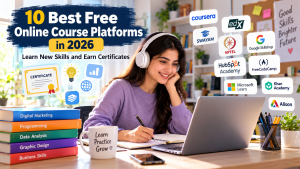
10 Best Free Online Course Platforms in 2026:-
1. SWAYAM — Free Online Courses from India
SWAYAM is an online learning initiative of India’s Ministry of Education. It provides courses across subjects such as science, engineering, management, humanities, and other academic fields.
Official website: https://swayam.gov.in/
What can you learn?
- Academic subjects
- Science and technology
- Management
- Humanities
- Various university-level topics
SWAYAM can be a useful option for students who want structured learning from recognised educational institutions.
Course access is generally free, but certification may require registration for an examination and payment of an applicable fee. Always review the requirements for your chosen course.
Best for: Students and learners interested in structured academic education.
2. NPTEL — Technology, Science, and Engineering Courses
NPTEL stands for the National Programme on Technology Enhanced Learning. It is an educational initiative involving the Indian Institutes of Technology (IITs) and the Indian Institute of Science (IISc).
Official website: https://nptel.ac.in/
NPTEL offers online courses in areas such as engineering, programming, computer science, mathematics, management, and science.
Popular learning areas include:
- Python programming
- Computer science fundamentals
- Data science
- Engineering subjects
- Business and management
Course enrolment and learning materials are generally free. A certificate may require taking a separate examination for which a fee applies.
NPTEL is particularly useful for learners who prefer structured courses with academic content and assessments.
Best for: Engineering students, technology learners, and people seeking a deeper understanding of technical subjects.
3. Coursera — Courses from Universities and Companies
Coursera is a popular online learning platform offering courses and professional learning programmes from universities and industry organisations.
Official website: https://www.coursera.org/
You can explore courses related to:
- Artificial intelligence
- Business and management
- Digital marketing
- Data analytics
- Information technology
- Personal development
Some Coursera courses offer free access to selected learning materials, while others require payment or a subscription. Certificate access and financial assistance options depend on the programme.
Before enrolling, check whether the course provides full free access or only a limited preview.
Best for: Learners interested in university-level education and industry-related skills.
4. edX — Learn from Leading Educational Institutions
edX offers online learning programmes in technology, business, science, computer science, and other subjects.
Official website: https://www.edx.org/
Depending on the course, learners may have access to free learning materials or an option to study without purchasing a verified certificate.
Some programmes require payment for graded assessments, certificates, or additional learning features.
Before choosing a course, review its syllabus, access period, certificate requirements, and total cost.
Best for: Learners who want structured online education in academic and professional subjects.
5. Google Skillshop — Learn Google Products and Digital Skills
Google Skillshop provides training related to Google products and selected professional skills.
Official website: https://skillshop.withgoogle.com/
Depending on the available training, you can learn about:
- Google Ads
- Google Analytics
- Online advertising
- Digital marketing tools
- Measurement and reporting
Some training programmes include assessments or certifications. The exact requirements vary by product and course.
Google Skillshop can be especially useful for people who manage websites, work in digital marketing, or want to understand online advertising.
Best for: Beginners interested in digital marketing and Google’s business tools.
6. HubSpot Academy — Free Marketing and Business Training
HubSpot Academy offers educational resources in marketing, sales, customer service, and related business subjects.
Official website: https://academy.hubspot.com/
Some popular learning areas include:
- Content marketing
- Social media marketing
- Email marketing
- Inbound marketing
- Sales and customer relationship management
Many HubSpot Academy courses and certifications are offered free of charge, although the exact conditions depend on the programme.
The platform is particularly useful for bloggers, content creators, small business owners, and people interested in online marketing.
Best for: Learners who want practical marketing and business knowledge.
7. freeCodeCamp — Learn Programming for Free
If you want to learn coding without paying for an expensive training programme, freeCodeCamp is worth exploring.
Official website: https://www.freecodecamp.org/
The platform provides interactive learning and practical exercises in areas such as:
- HTML and CSS
- JavaScript
- Responsive web design
- Python and other programming topics
- Data analysis and related technical subjects
Learners can build projects while developing their coding skills. Eligible certifications are available after completing the required curriculum and projects.
Unlike courses that focus mainly on watching videos, freeCodeCamp encourages hands-on learning.
Best for: Beginners who want to learn programming and web development.
8. Microsoft Learn — Technology, AI, and Cloud Computing
Microsoft Learn provides learning modules and structured paths related to Microsoft’s technologies.
Official website: https://learn.microsoft.com/
You can explore learning materials covering:
- Artificial intelligence
- Cloud computing
- Microsoft Azure
- Data and analytics
- Software development
- Microsoft business tools
Many learning modules are available for free. However, completing a free module is not necessarily the same as earning a formal Microsoft certification. Professional certification exams may require payment.
Check the requirements for the particular learning path or certification you want to pursue.
Best for: Learners interested in technology, cloud computing, and Microsoft-related skills.
9. Khan Academy — Free Academic Learning
Khan Academy provides free educational resources for students and independent learners.
Official website: https://www.khanacademy.org/
Its learning materials cover subjects such as:
- Mathematics
- Science
- Computing
- Economics
- School-level academic subjects
The platform is particularly useful for understanding concepts, revising lessons, and practising academic questions.
Khan Academy primarily focuses on learning rather than professional certificate collection, so it may be more appropriate for students who want to strengthen their knowledge.
Best for: School students and learners who need additional academic practice.
10. Alison — Online Courses Across Different Subjects
Alison offers online courses in professional development, business, technology, health and safety, and other areas.
Official website: https://alison.com/
Learners can explore courses covering topics such as:
- Project management
- Customer service
- Digital skills
- Business administration
- Workplace skills
Many courses can be studied for free, but the terms for certificates, diplomas, or other credentials may vary. Some certificate options involve a purchase.
Review the course and certificate conditions carefully before starting.
Best for: Beginners exploring different professional and workplace skills.
Comparison of the 10 Online Learning Platforms
| Platform | Main learning areas | Certificate considerations |
|---|---|---|
| SWAYAM | Academic subjects | Exam and applicable fees may apply |
| NPTEL | Engineering and technology | Separate examination may require payment |
| Coursera | University and professional courses | Depends on the course or programme |
| edX | Academic and professional subjects | Verified certificates may cost extra |
| Google Skillshop | Google products and advertising | Some training includes certifications |
| HubSpot Academy | Marketing and sales | Many course certifications are free |
| freeCodeCamp | Programming and web development | Eligible certifications can be earned free |
| Microsoft Learn | AI, cloud, and technology | Formal certification exams may cost extra |
| Khan Academy | School subjects and academic learning | Primarily focused on free learning |
| Alison | Business and professional skills | Certificate options may involve payment |
Note: Platform offerings, course availability, pricing, and certification requirements can change. Check the official website before enrolling.
Best Skills to Learn Online in 2026:
Choosing the right skill is just as important as choosing the right platform. Consider your interests, current abilities, and career goals before deciding.
1. Digital Marketing
Digital marketing includes search engine optimisation (SEO), content marketing, social media, email marketing, and online advertising.
It can be useful for bloggers, small business owners, content creators, and people interested in marketing careers.
Where to start: Google Skillshop and HubSpot Academy.
2. Web Development
Web development involves creating and maintaining websites. Beginners can start with HTML, CSS, and JavaScript before progressing to more advanced topics.
Practising by building small websites can help you develop a portfolio of work.
Where to start: freeCodeCamp.
3. Artificial Intelligence and Data Analysis
AI tools and data analysis are useful learning areas for people interested in technology and productivity.
You can begin with basic digital literacy, spreadsheets, data interpretation, and introductory AI concepts.
Where to start: Microsoft Learn and relevant courses on Coursera or edX.
4. Graphic Design
Graphic design involves creating visual content for websites, social media, presentations, and businesses.
Learn design principles, typography, colour combinations, and layout. Practise by creating original designs and organising them into a portfolio.
Where to start: Explore design-related courses on Coursera, edX, or other reputable learning platforms.
5. English Communication
Strong communication skills can be useful in education, customer service, remote work, and many professional settings.
Practise writing emails, speaking clearly, preparing for interviews, and understanding professional communication.
Where to start: Khan Academy’s available English-related learning resources and suitable language-learning courses on established platforms.
No skill guarantees employment or income. Your results depend on the quality of your practice, experience, portfolio, and the opportunities available to you.
How to Choose the Right Free Online Course
Before enrolling in any course, ask yourself the following questions.
1. Does the course match your goal?
Choose a course that teaches a skill you genuinely want to develop.
2. Is the entire course free?
Some platforms provide free introductory lessons but charge for the full programme.
3. Is the certificate free?
Read the certificate requirements carefully. Do not assume that free course access means a free certificate.
4. Is the course suitable for beginners?
If you are new to a subject, choose a course that explains the fundamentals before moving to advanced concepts.
5. Does it include practical work?
Projects, assignments, and exercises can help you apply what you learn.
6. Can you complete it with your available time?
Choose a realistic study schedule that fits your work, education, and family responsibilities.
7. Is the platform trustworthy?
Use official websites, review the course provider, and avoid paying for certificates without understanding their terms.
How to Learn a New Skill in 30 Days:
You do not need to study for several hours every day to make a start. A consistent schedule can help you build a learning habit.
Here is a simple 30-day plan for beginners.
| Days | Learning activity |
|---|---|
| 1–3 | Choose one skill and select a suitable course |
| 4–10 | Learn the fundamentals and take notes |
| 11–17 | Practise the lessons you have completed |
| 18–24 | Build a small project |
| 25–27 | Review mistakes and improve your work |
| 28–30 | Finish your project and plan the next stage |
This is a suggested schedule, not a guarantee of mastery. Some skills require months of regular practice before you become proficient.
Can Free Online Courses Help You Get a Job?
Yes, online courses can help you develop knowledge and demonstrate your interest in a particular field. However, completing a course does not automatically guarantee a job.
Employers may also look at your practical abilities, communication skills, work experience, qualifications, and ability to solve problems.
To improve your preparation:
- Choose courses related to the roles you want to pursue.
- Complete practical projects.
- Keep examples of your work in a portfolio.
- Add relevant certificates to your CV when appropriate.
- Practise interviews and workplace communication.
- Review job descriptions to understand the skills employers require.
For example, someone learning web development could build a simple website and share the finished project with potential employers.
A practical portfolio can demonstrate your abilities more clearly than a list of completed courses alone.
Frequently Asked Questions (FAQs)
1. Which website offers the best free online courses in 2026?
The best platform depends on your goal. SWAYAM and NPTEL are useful for academic learning, freeCodeCamp is suitable for programming, and Google Skillshop and HubSpot Academy offer training related to digital marketing and business tools.
2. Can I get a free online certificate?
Yes, some platforms offer free certificates when you complete the required lessons, assessments, or projects. Other platforms charge for certificates even when course materials are available for free.
3. Can I take online courses without a college degree?
Yes. Many introductory online courses are open to beginners without a college degree. However, individual courses, professional certifications, and jobs may have specific eligibility requirements.
4. Are free online certificates recognised by employers?
Recognition varies by employer, industry, course provider, and credential. A certificate may demonstrate learning, but it does not necessarily replace a degree, licence, or required professional qualification.
5. Can I complete an online course using a mobile phone?
Many platforms support mobile learning through a browser or app. However, some activities, particularly coding, data analysis, and graphic design, may be easier on a computer.
6. How long does it take to learn a new skill online?
It depends on the subject, your starting level, and the amount of time you practise. You may learn basic concepts in a few weeks, while developing professional proficiency can take considerably longer.
7. Do free online courses guarantee a job?
No. Courses can help you develop skills, but employment depends on many factors, including practical ability, experience, qualifications, and job-market conditions.
8. Should I take several courses at the same time?
Beginners often benefit from focusing on one main skill at a time. Completing a course and applying what you learn can be more useful than starting many courses without finishing them.
7 Effective Ways to Outshine in the Classroom
Final Thoughts:
Free online courses can provide an accessible way to develop new skills, explore career options, and strengthen your knowledge in 2026.
Platforms such as SWAYAM, NPTEL, Coursera, edX, Google Skillshop, HubSpot Academy, freeCodeCamp, Microsoft Learn, Khan Academy, and Alison offer different learning opportunities for different needs.
The best approach is to choose one relevant skill, study consistently, practise what you learn, and build something that demonstrates your abilities.
Remember that a certificate is only one part of your learning journey. Real understanding, practical experience, and continuous improvement matter just as much.
Start with one course today, set a realistic goal, and take the first step towards learning a valuable new skill.
If you found this guide helpful, share it with someone who wants to learn online and explore more educational resources on EducationalVIP.com.